"Younger Next Year"

Rabu, 10 Oktober 2012 0 komentar
Younger Next Year

 then, 1986 - Dad and Kool Kid in outdoor spa
       In an older post on this blog [Career Opportunity] I talked about retirement, how I put it off until the decision was more or less made for me. I wasn't sure how I would be able to cope without the routine of a 9 to 5 job. The last time I lived on my own time was in the mid 1980s when I lived in Kurashiki (as I mentioned in a previous post [A step back in time]) and worked as a freelance English conversation teacher. Aside from preparation and class time the rest of the time was my own. That worked out well since our baby was born in 1985 and I spent a lot of my extra time being a daddy and very much enjoyed the role


Mitsu Sports Center - a pleasant 25-minute
drive in the country from our house
        But when retirement loomed, the baby was a full grown man and on his own, so there wasn't the option of filling in the time being a daddy. That career track was blocked so I hit on the idea of making preventive health my occupation of choice in retirement. Men, especially, seem to have to have an occupation and/or a purpose in life. I had already begun doing some physical exercise, taking some supplements and watching what I eat due to some mildly alarming cholesterol levels and higher than normal BMI. As a result my cholesterol levels improved and my excess weight began to drop, gram by gram.
Mitsu Sports Center 25 meter pool
        This past summer I was already in pretty decent shape when I visited the States. When I got together with an old friend from college days, she gave me some CDs about weight training for older people with the odd-sounding title “Younger Next Year”. Well, being “younger next year” sounded like a great idea to me! I decided to make my health and fitness my new “career” goal and expanded the exercise regime that I was already doing to include some weight training, some yoga (that I had neglected since college days) and some swimming. This seems like a pretty well rounded and doable regimen for a guy of my age. It's a little rigorous, and the more neglected or less used parts of my body feel it, but I expect that in time even those recalcitrant joints, muscles and tendons will mellow out—at least to a reasonable extent. You can't expect to have the body of a 20 something again, after all.
now, 2012
        I try, on average, to work out alternating with weights and yoga five days a week, go to the pool one day and take one day off—Never on Sunday! Road buddy does her own exercise regimen and we go to the pool together. We took a few forbidden photos at the pool recently and stopped at a very picturesque Japanese restaurant on the way home feeling pleasantly body tired but hungry.

       So, if you're wondering what to do with all that retirement time, get up from the recliner, turn off the TV and make taking care of your health your new career. It'll keep you focused, do wonders for your body and your outlook. Guaranteed!  


landscaped Japanese style garden with restaurant 

A step back in time

0 komentar
oHIGANBANA
         With the blooming of the oHIGANBANA彼岸花(honorable equinox flower) the season has turned and the sweltering Japanese summer is blessedly behind us. It's autumn again and one gets the urge to get off the mats, move around and do a bit of local traveling. So it came to pass that a friend of ours was having an art exhibition at a gallery in the first town I lived in when I came to Japan in 1980—Kurashiki 倉敷
 
         It was purely by chance that I got dropped in Kurashiki to fend for myself (I didn't know a word of Japanese and couldn't read the signs) by my company representative in a beautiful town that time seemed to have forgotten, not to mention that the allied bombs of World War II had ignored as well. 


typical KURA with its black
and white tiles - upper right
         The core of the town is a canal surrounded by buildings that look unchanged since the Meiji Restoration (1868) period. The canal was a river port used to send rice and other goods down to the Seto Inland Sea. And many of the wooden buildings were storehouses and granaries (kura ) used for storing goods before shipping. 


K gallery - little white square in center of photo
(note the black and white tiles on right)
         Today, the old merchant quarter along the weeping willow lined canal areaknown as the Bikan Chiku, with its distinctive white-walled, black-tiled warehouses is a popular tourist destination in Japan. I lived in Kurashiki from 1980 to 1988. It's only around 15 miles from our present home and we like to take a sentimental journey there from time to time to visit the old haunts. And, this time, to drop in on our friend's art exhibition at K gallery in a small alley off the canal. 
 our Mitsubishi i
 
         So, yesterday, we hopped into the Mitsubishi i and struggled along for over an hour in ghastly traffic on this 3-day holiday weekend. The return trip was even ghastlier, but I wont dwell on the dark side and just show a few photos of my first home in Japan.


Bikan Chiku - weeping willow lined canal
Meiji period river port of Kurashiki
boat landing - canal rides for tourists in period boats
stone bridge over the canal with a typical KURA in background
traditional  RYOKAN  (Japanese Inn) on the canal
Ueda's coffee house - my old TAMARIBA (hangout) since 1980
Mrs. Ueda my old Mama-san - now 78 or so and still going strong
iced coffee - my favorite
iced tea - her favorite

Buddhist temple precinct on mountain behind our old house
our house in Kurashiki from 1982 - 1988
photo taken from temple mount

Bye bye Senkaku, hello Fuku

Senin, 08 Oktober 2012 0 komentar
The current (recent?) dispute over the ROCKS in the East China seems to have exceeded its “use by” date in terms of its usefulness as a hot news item—at least until the next flare up.


Does anybody remember the Fukushima nuclear disaster?
Yoshihiko Noda
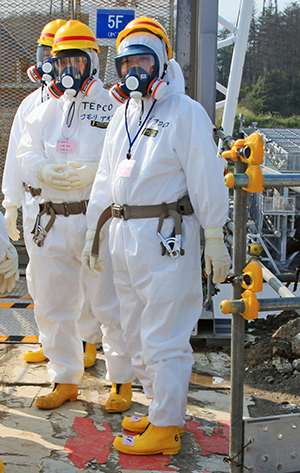
In what could be basically a photo op for the Democratic Party of Japan (DPJ) Prime Minister (Noda) in an attempt to shore up his dwindling popularity in the run up to a general election widely speculated to return power to a possible new coalition government headed by the Liberal Democratic Party (LDP), he paid an “inspection” visit to the crippled Fukushima nuclear plant. Apart from posing in a white protective suit and hard hat and expressing "heartfelt" thanks to the Tepco workers who risked their lives in the immediate aftermath of the tsunami disaster its hard to see what “inspection” value there was in a look see by someone who knows nothing about nuclear energy.

Be that as it may, an article in The Japan Times by staff writer Reiji Yoshida does give a bit of an update on the current conditions at Fukushima. The overall message seems to be that things haven't gotten worse but it will take a very long time to clean up the mess.

Since Fukushima has potentially much farther-reaching consequences than some rocks in the sea for people other than the nationalist nutjobs shooting water pistols at each other, sane people might be interested in learning about the current state of ongoing repairs or non-repairs there. Here are a few excerpts from the article:

Experts say that over the past year, the risk of another serious accident at the plant has considerably lessened, although long-term concerns about the durability of equipment and facilities remain since decommissioning the reactors could drag on for up to 40 years.
Plant workers are now speeding up work to remove about 1,500 nuclear fuel assemblies stored in a spent-fuel pool on the fourth floor of the No. 4 reactor building, which suffered extensive damage from a hydrogen explosion.
Tepco now plans to start extracting the fuel assemblies by the end of next year, and to finish moving them to another spent-fuel pool designed for long-term storage by the end of 2015.
Once accomplished, the likelihood of another serious accident will be even slimmer, according to Kyoto University professor Hajimu Yamana...
"There won't be any more serious trouble unless something extraordinary happens," Yamana said, pointing out that simulations by plant operator Tokyo Electric Power Co. showed the reactor 4 building can withstand an earthquake measuring upper 6 on the Japanese seismic intensity scale of 7.
But it's better to move all the spent fuel to the second pool, which is more resistant to earthquakes and has a better cooling system, Yamana noted, because "you can't totally deny the possibility of (another) gigantic earthquake" striking the area.
Meanwhile, the remaining decay heat from the nuclear fuel in the damaged reactor cores is estimated to have fallen to 1 megawatt from 2.35 megawatts over the past year as radiation is emitted, according to calculations by Tepco.
This has considerably reduced the risk of another disaster at the complex "and as time passes, (Tepco) will get greater scope" to fix the critical water coolant system, Yamana said.
The decay heat is expected to fall to 0.61 megawatt by next October and to 0.42 megawatt a year later, according to Tepco's data.

The question is how much trust and confidence you have in Tepco's calculations!