Fukushima Nuclear Meltdown Update
Fukushima from another by-the-numbers angle
For what it's worth and for those who are interested in the progress/lack of progress being made at the Fukushima Nuclear Power plant that was devastated by the killer tsunami on March 11, 2011, here is the latest update to appear in The Japan Times English language newspaper. The second link is by a non-Japanese writer in the Asia Times English language newspaper based in Hong Kong. Both articles leave little doubt about the ongoing seriousness of the Herculean task facing the decommissioning of this plant.
Tampilkan postingan dengan label Japan. Tampilkan semua postingan
Tampilkan postingan dengan label Japan. Tampilkan semua postingan
A concise history of nationalism in the 20th and early 21st Centuries
Rabu, 02 Januari 2013 0 komentar
Japan's steely resolve....
In this special essay to The Japan Times, Ronald Dore, a longtime student of Japanese society, examines the rise of nationalism in Europe and Asia and its evolution up to the present time. A rather lengthy (short of a whole history textbook) but fascinating read for anyone interested in how things work in the modern world and why things are the way they are; and concluding with a "hope" for one of the "wonders of 2013".
Will wonders never cease?
With the comeback kid, who knows?
 |
| Ronald Dore |
Will wonders never cease?
With the comeback kid, who knows?

Yubara Onsen – 湯原温泉
Jumat, 28 Desember 2012 0 komentar There is another side to Japan from its ancient temples, shrines and castle donjons.
Water.
 |
| hand and foot soaks on the roadside |
Japan is surrounded by it. It falls regularly from the skies. And, like life blood, it flows through the body of Japan in the arteries and veins of its brooks, streams and rivers. Some of that water is heated naturally deep in the earth, for Japan is in the Ring of Fire, the volcanic rim of the Pacific basin. If the Japanese have some kind of religious sacrament it would have to be cleanliness, and with water in such abundance it's not hard to understand why. Japan is known worldwide for its neatness and relative safety. The corollary to environmental neatness is personal cleanliness. Bathing is not merely a necessity here it is considered one of the great pleasures of life. The best venue for the pleasure of bathing is the 温泉町 “onsen machi” –hot spring resort—the phrase also connotes many other pleasures.
 |
| Asahi River in Yubara Onsen |
We are fortunate to live only a two-hour drive from the finest example of a natural hot spring in the western part of Japan (according to the town's PR spin brochure). All you have to do is follow the river upstream from Okayama City until you reach the hot spring town of Yubara where hot water actually flows into the Asahi River, the same river that flows all the way through Okayama into the Inland Sea. But, in Yubara, it's still more a stream than the big river that flows through our city. So, road buddy and I decided to kick off our winter travel with an overnight trip to Yubara Onsen for my birthday. As we got higher into the mountains the weather began to change rapidly. It was sunny when we left the house, but started snowing about half way. Perfect!
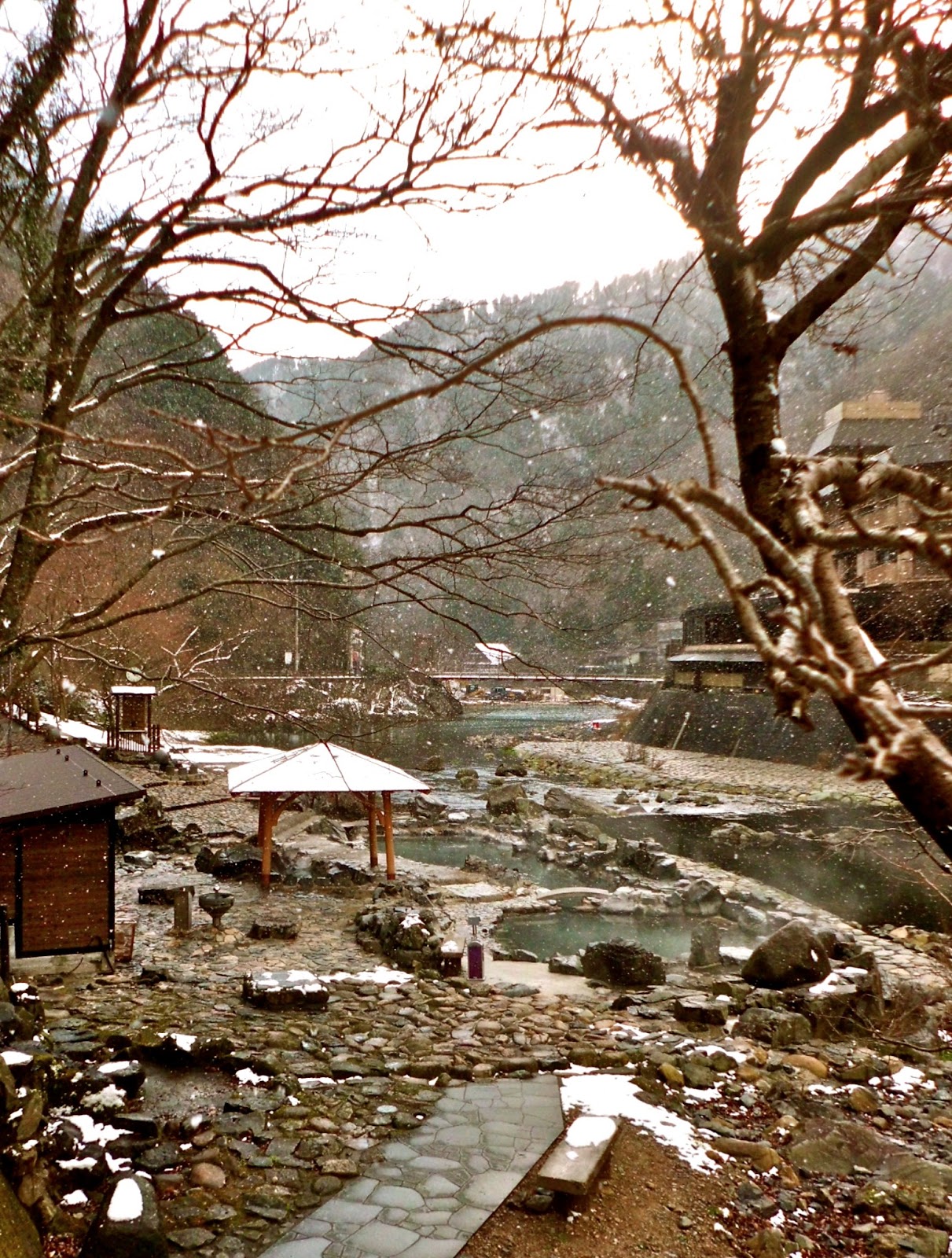 |
| hot spring pools - lower center |
 |
| entrance to the hot spring pools |
You see, the reason to go to Yubara Onsen is for the hot water pools that sit right in the Asahi River. Admission is free and bathing is both mixed and in the nude, swimwear is taboo. If you are shy and modest you would be unwise to go to the river pools. The ryokan – 旅館 – (inns) have same-sex bathing in privacy if you are shy of exposing your body in public. But, there is nothing on this planet to compare with the hot spring pools out in nature on a cold winter night with the snow falling. If you are really lucky, and we were, the clouds will break occasionally and the moon will peek through the falling snow.
 |
| our own private hot spring tub |
 |
| Madama Butterfly |
Our ryokan had its own hot tub filled with hot natural spring water piped right into the room. After we arrived and checked in we took a walk to the river pools. It was late afternoon and very cold so we were debating about going back out after dark. Returning to the ryokan we filled the hot tub, mixed a couple of Rusty Nail cocktails (scotch and Drambuie), opened a bar of dark chocolate and enjoyed a nice long soak before dinner. If you stay in a traditional Japanese inn you are provided with yukata – ゆかた – (sleeping kimono) which you can wear to go to dinner and even to go outside the inn if you wish. After reluctantly getting out of the tub we donned our yukata and went down to the private room where our dinner was prepared by an “Iron Chef”. We ordered some kanzake – 燗酒 – (heated sake) with dinner that boosted the effect of the Rusty Nails.
 |
| kanzake |
Being internally heated with sake we were feeling somewhat brave about going out to the river pools but still a little reluctant to go out in the cold. Yet, the memory and lure of the natural setting—we had been here before—finally overcame our reluctance. We put our down coats over the flimsy yukata and went out to the river. It didn't seem as cold as it had earlier even though we were wearing almost nothing (easier that way to get undressed quickly in the cold air to slip into the hot pool).
It is difficult to describe being in the hot spring in the cold, snowy open air. It is so idyllic. There were just a few other people when we arrived. It's chilly on bare skin until you slip into the hot water, then, miraculously, you don't feel the cold at all. Only your head is out of the water but the head and face are the least sensitive parts of the body to cold anyway. Nevertheless, the hot water penetrates quickly to the bones and you can soak for hours talking quietly just being alive. It is truly one of the most exquisite feelings I can think of offhand.
 |
| dressed to kill |
We stayed in the pools for over an hour and then got out, dressed and walked back to the inn not feeling the cold in the least—the penetrated heat holds for quite a while after getting out of the hot spring. After finally getting up in the morning we refilled the hot tub in the room and soaked a bit more before going to breakfast (mine western style, hers Japanese style).
 |
| hi tech instructions |
One more aspect of water usage in Japan I forgot to mention—hi-tech toilets. These marvels of the bowel movement have been around for a while, but being something of a naturalist I have avoided using them. However, all good resolutions meet their nemesis sooner or later and our inn had a hi-tech toilet that I had no choice but to use. Of course, I could have chosen to simply let if flush (by itself) and not to use the various toys on the wall panel, but curiosity finally got the better of me and I succumbed to a couple of the functions cutely illustrated on the panel. I will leave it to your imagination to decide which ones.
 |
| hiking at Takebe |
 |
| susuki - pampas grass |
It had continued to snow lightly overnight and the car had a light covering of snow, but the sun was shining and the road was clear enough so as not to present a driving hazard since I have no snow tires. We had a pleasant drive back on the back country roads along the Asahi River, stopped off to do some hiking on some woodsy trails that we know in Takebe, and arrived back home in the early afternoon. All in all, it was a great change of scene and a nice kick off for our upcoming trip to Europe in January.
Europe and Music Beckon the Wandering Spirit
Rabu, 19 Desember 2012 0 komentar |
| Xmas Cake |
'Tis the week before Xmas and all through our house no visions of sugar plums dance in our heads. We aren't doing Xmas this year. Here in Japan, a non-Christian nation, it isn't even a holiday. The commercial aspect is big here, and a sort of tradition of eating “Christmas cake” (a few strawberries on white icing) on the “Eve” of the 24th has taken hold. I used to have to take a paid vacation day when our son was younger and we made an effort to celebrate a semblance of the holiday with an artificial tree and stuffed turkey dinner (once we built our own house and had an oven big enough to roast it in).
 |
| Prague, Theater of the Estates |
Although no sugar plums dance in our heads, thoughts of another season of music and theater do. Our plans are coming together for another winter opera “season” in Europe. First, we'll be spending January in Berlin attending operas at the Schiller Theater (temporary home of Unter den Linden) and the Deutsche Oper in the Charlottenburg district of the city. We've rented in nice small serviced apartment in Charlottenburg within easy walking distance of both theaters. Opera buffs might be interested in our schedule: Lucia di Lamermoor, Freischutz, Don Giovanni, Maria Stuarda, Orfeus in the Underworld, Tosca and Un Ballo in Masquera. We are also attending an all-Mozart concert with the Berlin Philharmonic. Neither road buddy nor I have been to Berlin so we are both excited and looking forward to a new town and a new experience.
 |
| Vienna, Theater An der Wien |
In February and March we return to our beloved Prague. We have rented a charming serviced apartment near Bethlehem Square in an old building that used to be a convent. Our opera lineup includes: War with the Newts, Otello, Orpheus and Euridice, L'elisir D'amore, Rusalka, Turandot, Cavalleria Rusticana and Pagliacci, The Magic Flute, Die Fledermaus, and Carmen. Towards the end of February we return for a short stay in Vienna, after a two-year absence, to see the incomparable mezzo-soprano, Cecilia Bartoli, in Rossini's Le compte Ory, at the Theater An der Wien.
We are also stopping off in Istanbul and Ephesus for a week or so on the way back to Japan returning sometime in early April when the cherry blossoms bloom and the weather gets warmer.
HAPPY HOLIDAYS
TO EVERYONE
Taking Meaningful Action
Senin, 17 Desember 2012 0 komentar
Sasumata Demonstration
Yet again, the United States, has experienced a mass killing spree in a school. This time the victims were very young children mowed down by semi-automatic weapons fire. These kinds of atrocities have been occurring with such regularity, that they now seem the rule more than the exception. The anatomy of these killing sprees has also become routine. The loner apparently looking to go out in a blaze of glory finally turns the gun on himself. Then the media frenzy begins and the story is milked from every possible angle to achieve the maximum sensational effects: the agonized survivors wringing their hands and asking the unanswerable question—why?; media interviewers with microphone in your face asking “how you feel about all this”; the search for family and acquaintances of the perpetrator to delve into his [so far always a male] background and psychology; interviews with scholars and pundits analyzing what's wrong with our society that we have such regular and horrendous atrocities. The post-mortem goes on and on until the viewing public finally tires of it and moves on to some other sensational event, waiting for the next mass killing spree, and so on.
Here in Osaka a few years ago there was a similar mass killing at an elementary school. It quite shocked the Japanese people to the core considering that Japan is considered one of the safest countries in the world. At 10:15 in the morning of June 8, 2001, 37-year-old former janitor Mamoru Takuma entered the school armed with a kitchen knife and began stabbing numerous school children and teachers. He killed eight children, mostly between the ages of seven and eight, and seriously wounded thirteen other children and two teachers.
 |
| training in the use of sasumata |
Authorities acted swiftly and decisively setting up a program of self-defense to train teachers to handle such incidents should they occur again. The program included the use of “tools” to be used in fending off an armed attacker. In the traditional Japanese cultural ethos, this would be a collective effort by as many teachers as possible working together to fend of the attacker, buying time, until the police can be notified and arrive on the scene.
Japan has one of the strictest gun control regimes in the world. So, fortunately, from a certain point of view, mass killers aren't likely to use even a hand gun, let alone semi-automatic weapons in Japan. Their weapon of choice is usually a knife, far less deadly in terms of numbers of dead, and more easily subdued by a determined defense and restraint effort by cooperating trained people.
 |
| sasumata |
The main tools used in over 90% of public schools throughout the country are a two-pronged restraining tool called a "sasumata" and pepper spray. They are kept in plain sight and convenient to reach and grab by trained and rehearsed staff. They are actually relatively inconspicuous and seem to blend into the decor of the classroom and halls.
Granted the United States has a far more serious and intractable problem with school security than Japan. The problem is directly related to the easy access to powerful weaponry designed more for the battlefield than for sport. I recently made a somewhat Swiftian proposal to the effect that teachers may need to be armed to protect their young charges. But one could easily imagine a pitched shootout of the OK corral variety occurring in a second grade classroom with the terrorized children cowering under their desks.
Still, there is precedent and a model for “meaningful” action in response to mass killing of elementary students in Japan. Surely, US authorities could bang their heads together and come up with something better than locking the barn door after the horse has escaped. And something needs desperately to be done about the easy access to weapons of mass destruction.
Day trip to the Sea of Japan (日本海の旅行)
Sabtu, 24 November 2012 0 komentar |
| autumn foliage along the Takahashi River - (高橋川) |
Road buddy (a.k.a. my wife), who works freelance as a translator, got a call from an agency she does work for last week wanting to know if I'd be interested in doing a one off gig. I said it depends, what do they want me to do? The idea was that I would go to (松江) Matsue (a city about 2 ½ hours from here on the Japan Sea coast by train) and meet with a couple of consultants who wanted to get a foreigner's take on what would make tourism more appealing for foreigners in Matsue [pronounced mat-sue-ay as in way].
The notion of a day trip sounded appealing but I wanted to know what they were looking at in terms of compensation, i.e., money. It turned out that they were offering train fare but only what I considered to be inadequate pay for the time and effort I would have to put into it (it was an all day commitment including time on the train and the gig itself), so I turned it down.
 |
| Yakumo - train from Okayama to Matsue |
 |
| SRO |
 I arrived at Matsue (means Pine Cove) Station around 12:40 p.m. and met the consultants. It turned out that neither of them spoke English and I was forced to use my far from fluent Japanese. Another foreigner had also been hired for the gig and she soon arrived, a young woman from Australia. Without going into a lot of detail, they wanted us to walk around a couple of shopping areas and get our impression of how appealing these shops would be to foreign tourists.
  |
| Matsue Castle - 松江城 |
 |
| Lafcadio Hearn |
 |
| young people doing a traditional dance - outside Matsue Station |
 |
| tourist bus |
 |
| period boat on old castle moat |
 |
| perfect for a rainy day |
 |
| beautiful garden in expensive Japanese restaurant |
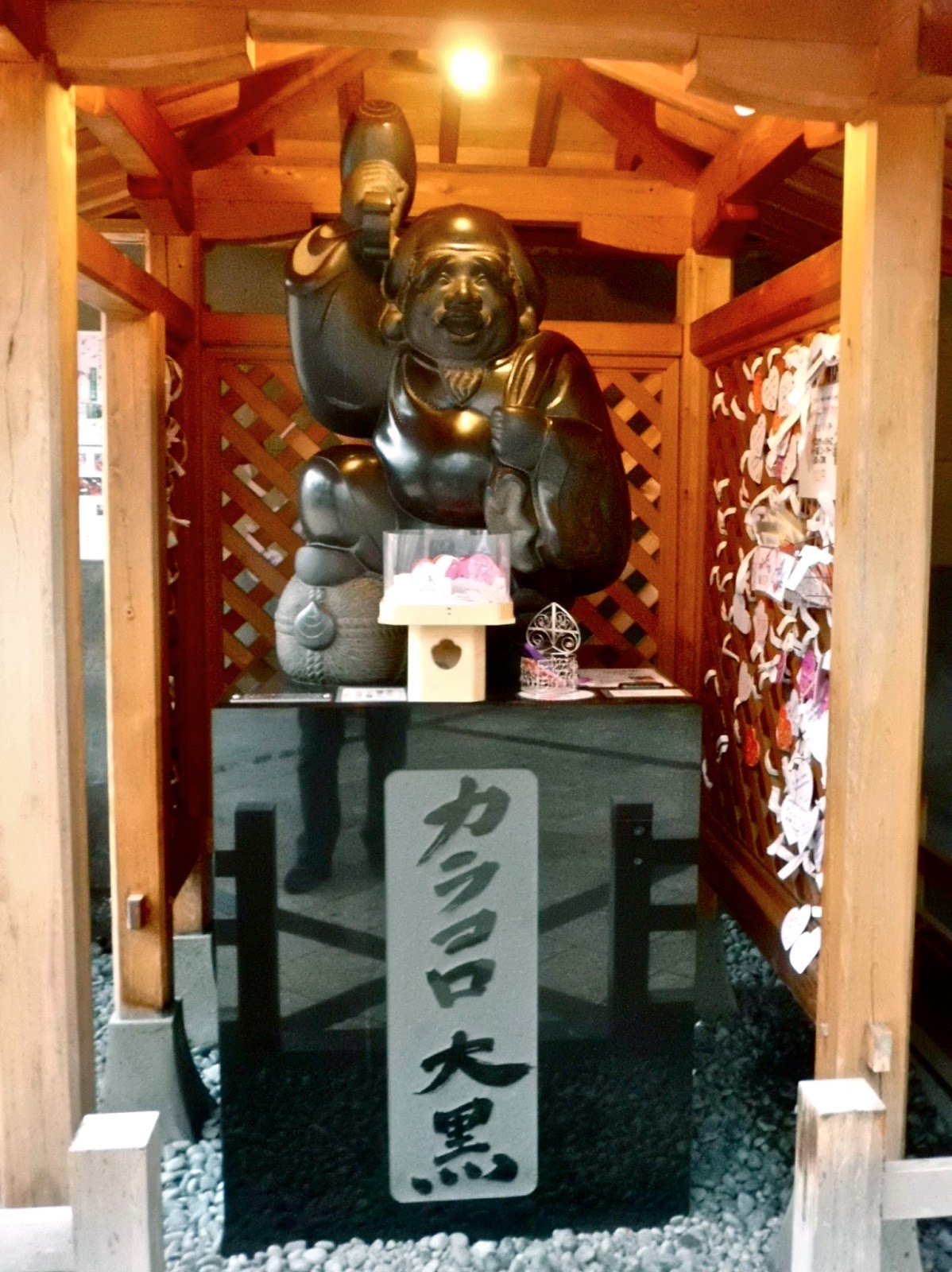 |
| one of the 7 good luck gods in Shinto |
 |
| holy of holies in a Shinto shrine - the small building in back with the horned roof |
 |
| a rather quaint izakaya - bar/restaurant |
 |
| mobile Starbucks giving away free latte samples |
 |
| weary travelers on the night train |
 |
| another weary traveler on the night train |
 |
| how things look to a bleary-eyed traveler on the night train |
the KKK
Rabu, 14 November 2012 0 komentar |
| Black Crow Castle and Asahi River |
Usually, road buddy and I go to the pool on Wednesday afternoons, but the pool was closed for cleaning this week so we decided to kill two birds with one stone by substituting walking for swimming and strolling among the autumn splendor of Koraku-en and the adjacent Black Crow Castle of Okayama. Koraku-en was once a private garden built during the Edo period in 1700 by Ikeda Tsunamasa, lord of Okayama. It is built on an island in the Asahi River across from the castle.
 |
| tea house in secluded glen |
Here are a few photos I took during our walk in the park and surrounding area.
 |
| boats on the Asahi River |
 |
| red maples beneath the castle ramparts |
 |
| Black Crow Castle across the river from Korakuen garden |
 |
| sculpted pine and maple trees |
 |
| zigzag bridge of wooden planks |
 |
| ripe persimmon tree |
 |
| autumn splendor |
Most Evil Corporation of the Year Award
Jumat, 26 Oktober 2012 0 komentar Probably everyone knows about “BLACK OPS”, but have you heard about “BLACK CORPS”?
 It's the little known underbelly of corporate Japan where companies that exploit their labor force have mushroomed since the halcyon days of the lifetime employment system—the vaunted cradle to grave security offered to Japanese salarymen in the heady days of Japan's post-war recovery and economic development. Then the bubble burst leading to now going on 20 years of economic stagnation and a fractured labor market where a significant portion of a whole generation is being forced into part time, low pay, no benefits jobs.
 This lost generation of young people are called フリーターFREETAs (involuntarily in part time jobs) and NEETs (not in education or employment or training). The nuance of these appellations is something that is undesirable. A large segment of a whole generation is adrift in a working world that has little use for them; they are as dispensable as paper diapers, scraping a living on the margins of the business world, sleeping in cheap coffin hotels or cubicles in all-night Internet cafes that don't ask too many questions or living at home off the pensions of aging parents. (There have even been incidents of family members failing to report the death of a pensioner, stashing the desiccated body in the bedroom for 30 years in one case, and continuing to collect the pension.)
Into the breach step the “black corporations”. Companies that are happy to hire people desperate for any kind of work and abuse them in near slavery conditions. Some of these are well known companies in Japan who show their best face to the public and even establish a reputation as benevolent philanthropists. There is the case of a young woman who worked for a restaurant chain whose owner, Miki Watanabe, was honored by Forbes for his work building schools and orphanages in countries like Nepal and Cambodia. “In the same year as the Forbes honor, Mina Mori, a 26 year-old employee of one of his Watami restaurants committed suicide only two months into her employment. Itwas discovered that she had worked 140 hours of [unpaid] overtime in one month before her death. The incident was just recently officially declared a case of karoshi (death by overwork).” [Watami won the “Most Evil Corporation” award, by the way.]
Her case is not unusual for people employed by black corporations. “In Japanese, the term 'black business' refers to companies who rake in huge profits while exploiting their own work force by discrimination, harassment, unpaid overtime, and short-term contracts.This type of business is a widespread problem in Japanese society but often goes undiscussed in mainstream media.”
The issue of black corporations was brought to my attention just recently by a program on NHK television (Japan Broadcasting Company). One abused employee interviewed on the program is suing her company for abuse. She described being systematically pressured to quit after the first month of employment by her boss. He would call her into his office and verbally browbeat and abuse her for sometimes two or three hours at a time. She was smart enough to bring a tape recorder to at least one of these torture sessions to use as evidence in a court of law.
The article on the linked website (Rocket News 24) lists the 12 most evil companies in Japan engaged in black business operations. It may come as no surprise that Tepco of Fukushima nuclear meltdown fame is on the list.
And these are just the tip of the iceberg!
Quotes are from the linked article on the Rocket News 24 website.
Closing the barn door...
Minggu, 14 Oktober 2012 0 komentar...after the horse's escaped.
やっぱり - YAPPARI
Just as everyone thought.
Tepco (Tokyo Electric Power Company) “finally admits [that the] nuke crisis [was] avoidable”.
An investigation by Tepco's own in house task force concluded that the company “was aware safety improvements were necessary long before last year's quake and tsunami caused ... but failed to act because it feared the political, economic and legal consequences of implementing new measures.”
Furthermore, “the utility could have mitigated the impact of the Fukushima meltdowns if it had diversified the plant's power and cooling systems by paying closer heed to international standards and recommendations [and] Tepco also should have trained its employees in practical crisis-management skills, rather than conducting obligatory safety drills as a mere formality...”
A five-member member committee headed by former U.S. nuclear regulatory chief Dale Klein set up to monitor Tepco's internal task force reform plan concluded: "It's very important for Tepco to recognize the need to reform and the committee is very anxious to facilitate the reforms necessary for Tepco to become a world-class company... The committee's goal is to ensure that Tepco develops practices and procedures so an accident like (the Fukushima meltdowns) will never happen again."
 NEVER HAPPEN AGAIN? We seem to hear those brave new words after every major screw up has occurred. It has the moral equivalence of “Oops! Sorry, folks. We'll be sure to keep the barn door closed next time.” Until “the next time” finds the barn door wide open once again.
 But Tepco's apparently on top of it now if you have faith in Tepco's self serving pronouncements –like this one: Takafumi Anegawa, Tepco's official in charge of nuclear asset management said: ...”the task force plans to compile recommendations by year's end 'that would have saved us from the accident, if we were able to turn back the clock'."
Hmmm, yes, well....
"Younger Next Year"
Rabu, 10 Oktober 2012 0 komentar
Younger Next Year
In an older post on this blog [Career Opportunity] I talked about retirement, how I put it off until the decision was more or less made for me. I wasn't sure how I would be able to cope without the routine of a 9 to 5 job. The last time I lived on my own time was in the mid 1980s when I lived in Kurashiki (as I mentioned in a previous post [A step back in time]) and worked as a freelance English conversation teacher. Aside from preparation and class time the rest of the time was my own. That worked out well since our baby was born in 1985 and I spent a lot of my extra time being a daddy and very much enjoyed the role
But when retirement loomed, the baby was a full grown man and on his own, so there wasn't the option of filling in the time being a daddy. That career track was blocked so I hit on the idea of making preventive health my occupation of choice in retirement. Men, especially, seem to have to have an occupation and/or a purpose in life. I had already begun doing some physical exercise, taking some supplements and watching what I eat due to some mildly alarming cholesterol levels and higher than normal BMI. As a result my cholesterol levels improved and my excess weight began to drop, gram by gram.
This past summer I was already in pretty decent shape when I visited the States. When I got together with an old friend from college days, she gave me some CDs about weight training for older people with the odd-sounding title “Younger Next Year”. Well, being “younger next year” sounded like a great idea to me! I decided to make my health and fitness my new “career” goal and expanded the exercise regime that I was already doing to include some weight training, some yoga (that I had neglected since college days) and some swimming. This seems like a pretty well rounded and doable regimen for a guy of my age. It's a little rigorous, and the more neglected or less used parts of my body feel it, but I expect that in time even those recalcitrant joints, muscles and tendons will mellow out—at least to a reasonable extent. You can't expect to have the body of a 20 something again, after all.
I try, on average, to work out alternating with weights and yoga five days a week, go to the pool one day and take one day off—Never on Sunday! Road buddy does her own exercise regimen and we go to the pool together. We took a few forbidden photos at the pool recently and stopped at a very picturesque Japanese restaurant on the way home feeling pleasantly body tired but hungry.
 |
| then, 1986 - Dad and Kool Kid in outdoor spa |
 |
| Mitsu Sports Center - a pleasant 25-minute drive in the country from our house |
 |
| Mitsu Sports Center 25 meter pool |
 |
| now, 2012 |
So, if you're wondering what to do with all that retirement time, get up from the recliner, turn off the TV and make taking care of your health your new career. It'll keep you focused, do wonders for your body and your outlook. Guaranteed!
 |
| landscaped Japanese style garden with restaurant |
Langganan:
Postingan (Atom)


